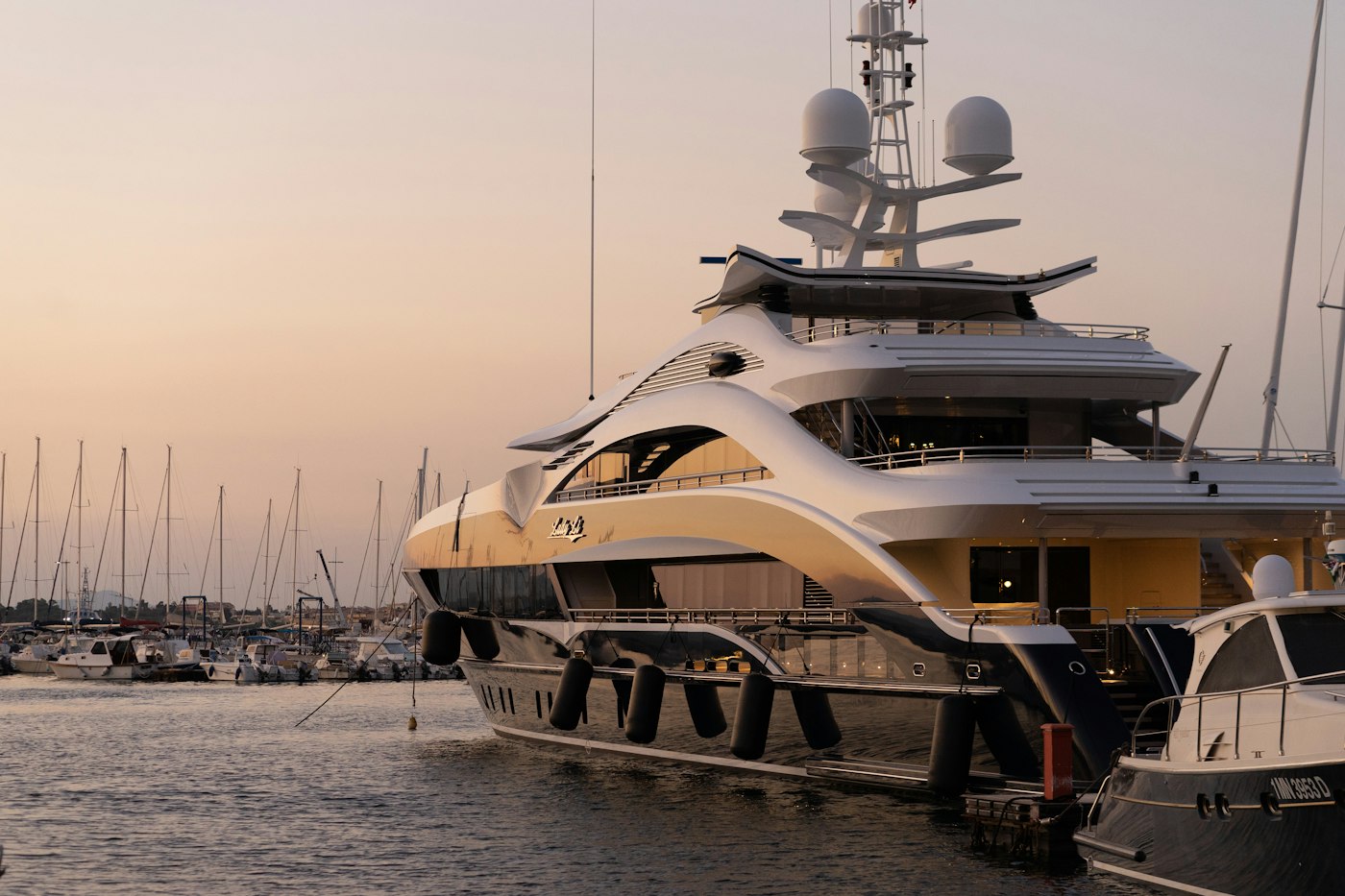
Catamaran vs Motor Yacht: Which to Charter in Marbella
Catamaran or motor yacht in Marbella? We compare stability, speed, space, cost, and local routes so you can pick the right charter for your Costa del Sol trip.
The 30-second answer
For a Marbella charter, choose a catamaran if you want stable decks, shallow-draft access to coves, and a party-friendly layout. Choose a motor yacht if you want speed, a sunbed-forward bow, and the ability to cover long distances in half the time. Both come with a licensed skipper, so you don't need a licence. Your decision comes down to whether you value space and stability (catamaran) or speed and sleek lines (motor yacht). This guide breaks down the differences for Puerto Banús, Marbella Marina, and other Costa del Sol ports.
Stability and motion: why catamarans win for seasickness
Catamarans have two hulls, which means they don't heel (tilt) like a monohull. If you or your guests are prone to seasickness, a catamaran is the obvious choice. On the Costa del Sol, the Mediterranean is generally calm from May to October, but even a moderate chop off Cabopino or Estepona can make a monohull rock. A catamaran's wide beam (often 8-10 metres) provides a stable platform; you can walk around without holding on, and drinks stay on tables. Motor yachts, especially those with deep-V hulls, cut through waves but still roll side to side at anchor. If you plan to anchor for lunch at Cala del Faro or spend hours lounging, a catamaran's stability is a genuine advantage. That said, modern stabiliser systems on larger motor yachts (40+ metres) can reduce roll significantly, but those boats cost a lot more. For a standard 40-50 foot charter, the catamaran will feel more like a floating terrace.
Speed and range: motor yachts cover more coastline
Motor yachts are faster. A typical 40-foot motor yacht cruises at 20-25 knots, while a 40-foot catamaran under power does 8-12 knots. That difference matters if you want to reach the Strait of Gibraltar (dolphin spotting) from Puerto Banús in 45 minutes instead of 2 hours. Or if you want to go from Marbella Marina to Nerja caves (about 50 NM) in a single day and still have time for a swim. Catamarans can cover the same distance, but you'll spend more time travelling and less time at anchor. On the flip side, catamarans have better fuel efficiency. A motor yacht burns roughly 100-200 litres per hour at cruising speed, while a catamaran uses 30-50 litres per hour. For a half-day charter, the fuel cost difference might be EUR 200-400. For a full day, it could be EUR 500-800. Some charter companies include fuel in the price; others charge it on top. Always ask. If your plan is to stay close to port (e.g., Puerto Banús to Cabopino and back), a catamaran's slower speed is fine. If you want to explore Sotogrande, Estepona, and Gibraltar in one day, a motor yacht is the better bet.
Space and layout: catamarans have more deck area
Catamarans offer more usable deck space per foot of length. A 40-foot catamaran has a beam of about 8 metres, compared to a 40-foot motor yacht's beam of 4-5 metres. That extra width translates into a larger flybridge, a bigger sundeck, and a wider saloon. For groups of 8-12 people, a catamaran feels spacious. You can have a dining area forward, a lounge area aft, and still have space for sun loungers. Motor yachts, especially those with a sleek, sporty profile, have narrower decks. The bow on a motor yacht is often a sunpad, but the sides are tight. The aft cockpit is usually the main social area. If you want to entertain with a barbecue, a DJ setup, or a sit-down meal for 10, a catamaran's layout is more flexible. However, motor yachts often have a better flybridge design for sunbathing, with a forward-facing bench and a bimini top. Catamarans sometimes have a flybridge that feels more like a second helm station than a lounging area. The choice depends on how you plan to use the space: do you want a party deck or a sunbathing platform?
Cost comparison: which is cheaper to charter
Generally, catamarans are slightly cheaper than motor yachts of the same length and age. A 40-foot catamaran in Marbella might cost from around EUR 2000-3000 for a full day, while a 40-foot motor yacht starts at EUR 2500-4000. The gap widens with size: a 50-foot motor yacht can cost EUR 4000-6000, while a 50-foot catamaran is EUR 3000-5000. Those prices include a skipper and basic insurance but not fuel, food, or port fees. Fuel is the big variable. As mentioned, catamarans burn less fuel, so a full-day charter on a catamaran might include EUR 300-500 in fuel, while a motor yacht could add EUR 600-1000. Port fees for berthing at Puerto Banús or Estepona are similar for both types (EUR 50-150 per night). If you're on a budget, a catamaran often gives you more space for less money. But if you want a specific experience (e.g., a high-speed run to Gibraltar or a luxury brand like Sunseeker), you'll pay a premium for the motor yacht. Always check the charter company's terms: some include fuel, others charge it separately. Ask for a full breakdown before booking.
Local routes and destinations: which boat suits which trip
The Costa del Sol offers diverse itineraries, and the boat type can enhance or limit your options. For a trip to the Strait of Gibraltar (dolphins and whale watching), a motor yacht's speed is a clear advantage. You can leave Puerto Banús at 10 AM, reach the strait by 11, spend an hour with the dolphins, and be back for lunch at Cala del Faro by 1 PM. A catamaran would take 2.5 hours each way, leaving less time for wildlife. For a leisurely cruise to Cabopino or the dunes of Artola, a catamaran's shallow draft (1-1.5 metres) lets you anchor close to the beach, where a motor yacht with a deeper draft (1.5-2.5 metres) might need to stay further out. The same applies to the Río Verde estuary near Marbella: only shallow-draft boats can enter. For a sunset cruise along the Marbella coastline, both work fine, but a catamaran's wide deck is better for a group of 10-12 people sipping cava. If you want to visit Estepona old town from the sea, the marina there accommodates both, but the approach channel is narrow; a catamaran's twin engines make manoeuvring easier. For a trip to Nerja caves (50 NM east), a motor yacht is the only practical choice for a day trip. A catamaran would need an overnight stop. Ultimately, your itinerary dictates the boat.
Onboard amenities and comfort: what to expect
Both catamarans and motor yachts offer similar amenities: a saloon with air conditioning, a galley (kitchen), a toilet (head), and a shower. The differences lie in the details. Catamarans typically have two or three cabins, each with its own en-suite bathroom, making them ideal for couples or small groups who want privacy. The saloon on a catamaran is usually at the same level as the aft deck, creating an open-plan indoor-outdoor flow. Motor yachts, especially those with a sport-fisher or express cruiser layout, often have the saloon one level down, with the helm station on the main deck. This can make the interior feel more enclosed. On a motor yacht, the master cabin is usually midship and spacious, but guest cabins may have shared bathrooms. For a group of 6-8, a catamaran's layout is more egalitarian. For a couple or a small family, a motor yacht's design might feel more luxurious. Both types typically include a sound system (Bluetooth or USB), a fridge, and a gas grill on the aft deck. Some larger motor yachts have a hydraulic swim platform, which makes boarding from the water easier. Catamarans often have a fixed swim platform between the hulls, which is stable and wide. If you plan to swim, snorkel, or use paddleboards, both work, but the catamaran's platform is usually more accessible.
Weather and seasonality: which boat handles conditions better
Marbella enjoys 300+ days of sunshine a year, but the sea state varies. From June to September, the Mediterranean is calm, with light winds and small waves. Both boat types are comfortable. In May and October, you might encounter a moderate chop, especially in the afternoon when the Levante wind picks up. Catamarans handle choppy seas better because of their stability; they don't pitch as much. Motor yachts can be uncomfortable in a beam sea (waves hitting the side) but handle head seas well. In the winter months (November to March), the sea can be rougher, and many charter companies only operate on request. If you do charter in winter, a motor yacht with a fully enclosed saloon and heating is more comfortable. Catamarans have more exposed deck space, which can be cold. For the typical Marbella summer charter, both are fine. The deciding factor is wind: if the forecast shows 15+ knots, a catamaran will feel more stable. If it's flat calm, a motor yacht's speed becomes the advantage. Your skipper will advise on the day's conditions. Some companies offer a weather guarantee, allowing you to reschedule if conditions are poor. Always ask about this policy.
Environmental considerations: fuel consumption and emissions
Catamarans are generally more fuel-efficient per passenger. A 40-foot catamaran burns about 30-50 litres per hour at 8-10 knots, carrying 10 passengers. That's 3-5 litres per person per hour. A 40-foot motor yacht at 20 knots burns 100-150 litres per hour for the same number of passengers, or 10-15 litres per person per hour. Over a full-day charter (8 hours), the catamaran uses 240-400 litres, the motor yacht 800-1200 litres. At current fuel prices (around EUR 1.50-2.00 per litre for marine diesel), the motor yacht's fuel cost is EUR 1200-2400 versus EUR 360-800 for the catamaran. If you're environmentally conscious, the catamaran has a lower carbon footprint. Some charter companies in Marbella are starting to offer hybrid or electric boats, but they are rare. For now, the choice is between a slower, more efficient catamaran and a faster, less efficient motor yacht. If you want to offset your emissions, some companies offer carbon offset programmes. Ask your charter broker about options. Also note that catamarans have less wake, which is better for the coastline and marine life. Motor yachts, especially at high speed, create a larger wake that can erode beaches and disturb wildlife. In sensitive areas like Cabopino dunes, some marinas enforce no-wake zones.
Common questions
Which is better for a party: catamaran or motor yacht?
A catamaran's wide deck and stable platform are better for a party with 10-15 people. You can dance, set up a DJ, and move around freely. Motor yachts have narrower decks and less space for a large group.
Do I need a licence to charter a catamaran or motor yacht in Marbella?
No. Every charter on BoatHire24 includes a licensed skipper who handles navigation, mooring, and safety. You just relax and enjoy.
Which boat type is cheaper for a half-day charter?
Catamarans are generally cheaper for half-day charters (4 hours), starting from around EUR 1500-2000, versus motor yachts from EUR 2000-3000. Fuel costs are also lower on catamarans.
Can I take a catamaran from Puerto Banús to Gibraltar in one day?
Yes, but it will take 2-3 hours each way, leaving limited time for dolphin watching. A motor yacht can do the round trip in half the time, giving you more time on the water.
Which boat is better for families with children?
A catamaran's stability and wide deck are safer for children. The shallow draft allows anchoring close to beaches. Motor yachts have higher freeboards and less deck space, which can be tricky with small kids.
Are there any licence-free day boats available?
Yes, BoatHire24 offers licence-free day boats (usually small motorboats or RIBs) that you can drive yourself without a licence. They are limited to certain areas and speeds, and you must be over 18. See our search page for options.
What is the best time of year for a catamaran charter in Marbella?
June to September offers the calmest seas, warmest weather (25-30°C), and longest daylight hours. May and October are also good but can be windier. Catamarans handle the wind better than motor yachts.
For more on choosing the right boat, read our blog or browse all options on BoatHire24. If you're still unsure, contact us and we'll match you with the best boat for your group size, budget, and itinerary.
Related guides
- Motor Yacht Charter Marbella: Luxury & Speed
- Luxury Motor Yacht Hire Marbella: Premium Charter Deals
- Luxury Motor Yacht Charter Marbella Day
- Luxury Motor Yacht Rental Marbella Day, Day Charter Deals
- Marbella vs Puerto Banús: Which Departure Port to Choose
- Fishing Charter Costa del Sol: Deep Sea Guide
Own a boat? GetMyBoat Alternative: BoatHire24.
Frequently Asked Questions
Which is better for a party: catamaran or motor yacht?▾
A catamaran's wide deck and stable platform are better for a party with 10-15 people. You can dance, set up a DJ, and move around freely. Motor yachts have narrower decks and less space for a large group.
Do I need a licence to charter a catamaran or motor yacht in Marbella?▾
No. Every charter on BoatHire24 includes a licensed skipper who handles navigation, mooring, and safety. You just relax and enjoy.
Which boat type is cheaper for a half-day charter?▾
Catamarans are generally cheaper for half-day charters (4 hours), starting from around EUR 1500-2000, versus motor yachts from EUR 2000-3000. Fuel costs are also lower on catamarans.
Can I take a catamaran from Puerto Banús to Gibraltar in one day?▾
Yes, but it will take 2-3 hours each way, leaving limited time for dolphin watching. A motor yacht can do the round trip in half the time, giving you more time on the water.
Which boat is better for families with children?▾
A catamaran's stability and wide deck are safer for children. The shallow draft allows anchoring close to beaches. Motor yachts have higher freeboards and less deck space, which can be tricky with small kids.
Are there any licence-free day boats available?▾
Yes, BoatHire24 offers licence-free day boats (usually small motorboats or RIBs) that you can drive yourself without a licence. They are limited to certain areas and speeds, and you must be over 18. See our search page for options.
What is the best time of year for a catamaran charter in Marbella?▾
June to September offers the calmest seas, warmest weather (25-30°C), and longest daylight hours. May and October are also good but can be windier. Catamarans handle the wind better than motor yachts.